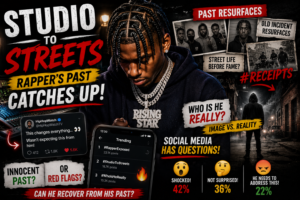


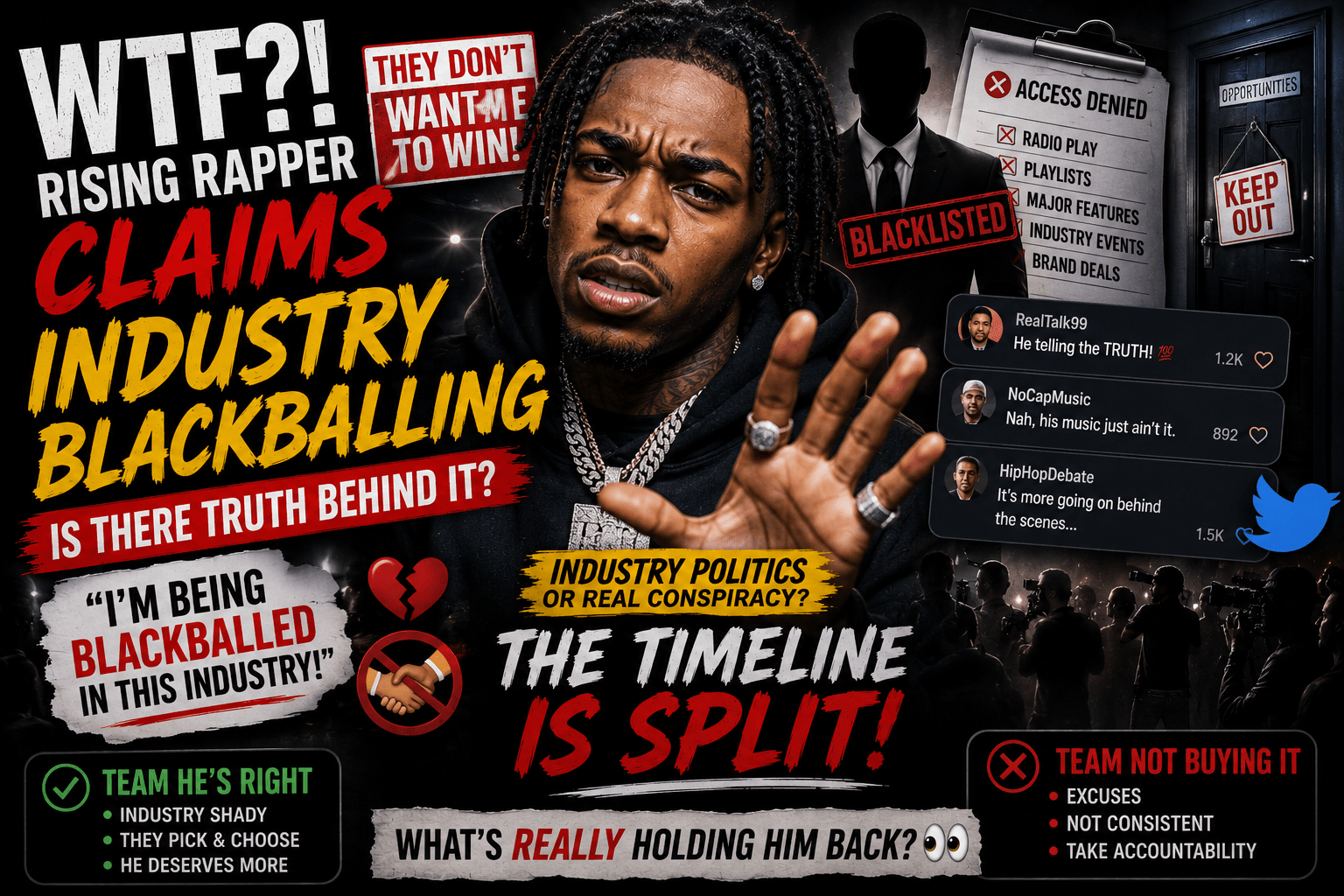
A rising rapper is trending online after publicly claiming that the music industry is actively working against him, sparking a heated debate across social media. The artist, who had been steadily building momentum, took to his platform to suggest that his career isn’t slowing down due to lack of talent or effort, but because of forces behind the scenes blocking opportunities.
While nothing has been officially confirmed, the claims have quickly gone viral, with fans and critics alike trying to figure out whether there’s truth behind the situation or if it’s simply frustration playing out in public.
The conversation started when the rapper posted a series of messages and videos suggesting that something wasn’t adding up in his career. According to him, doors that should be opening aren’t, and opportunities that once seemed within reach are now suddenly out of reach. He didn’t point to one specific incident but instead described a pattern that, in his view, points to industry interference.
Almost immediately, the internet picked it up.
Clips of his statements began circulating, and within hours, the discussion had expanded far beyond his fanbase. People who hadn’t followed his career before were now watching closely, trying to understand what exactly was going on.
At the center of the conversation is one word: blackballing.
For many, the term carries weight. In the music industry, being blackballed generally refers to an artist being intentionally excluded from opportunities, whether that’s radio play, playlist placements, collaborations, or even behind-the-scenes support. It suggests that certain gatekeepers are making decisions that limit an artist’s ability to grow, regardless of their talent.
If true, it’s a serious claim.
And that’s exactly why the reactions have been so divided.
Some fans immediately supported the rapper, saying that situations like this happen more often than people realize. They pointed out that the music industry has a long history of politics, favoritism, and behind-the-scenes decisions that the public never fully sees. From their perspective, it wouldn’t be surprising if an artist with potential was being held back for reasons unrelated to their music.
Others, however, were more skeptical.
A large portion of the audience questioned whether the issue might be something else entirely. They argued that many artists make similar claims when their momentum slows down, suggesting that not every setback can be blamed on the industry. For them, the conversation quickly turned toward the music itself, asking whether the rapper’s recent work was strong enough to compete in an increasingly crowded space.
This split in opinion has kept the debate active.
As more people joined the discussion, many began looking deeper into the rapper’s career. They revisited his older releases, checked his streaming numbers, and examined his growth over time. Some noticed that he did, in fact, have a period where his buzz was building. There were moments when his name was gaining traction, and his music was reaching new audiences.
But then, according to some observers, that momentum seemed to slow.
That’s where the questions started.
Was that shift the result of industry interference, as he claims? Or was it simply part of the natural cycle that many artists experience? In today’s music landscape, where new talent emerges constantly and trends change rapidly, maintaining consistent growth is already difficult, even without external obstacles.
The truth, as many pointed out, is rarely simple.
Behind the scenes, the music industry is complex. It’s not just about talent or popularity. There are contracts, relationships, business decisions, and strategic moves that influence who gets promoted and who doesn’t. Labels prioritize certain artists, playlists are curated with specific goals in mind, and collaborations often depend on connections as much as creativity.
Because of this, some people believe that blackballing is not only possible, but real.
At the same time, others argue that the term is sometimes used too loosely. They suggest that while industry politics do exist, they are not always the primary reason for an artist’s struggles. In some cases, they believe factors like consistency, branding, and audience connection play a much bigger role.
This is where the conversation becomes more nuanced.
Rather than choosing one side, some viewers have suggested that both things can be true at once. It’s possible that the rapper is facing challenges within the industry while also needing to refine certain aspects of his career. The idea that success depends on multiple factors, not just one, has resonated with many people following the story.
Another layer to the discussion is the role of timing.
In the music world, timing can be everything. An artist might release strong music, but if it doesn’t align with current trends or if it gets overshadowed by bigger releases, it may not gain the attention it deserves. Similarly, missing key opportunities or failing to capitalize on momentum can lead to a noticeable slowdown.
For some, this explanation feels more realistic than a coordinated effort to block someone’s success.
Still, the rapper’s continued statements have kept the situation alive.
Instead of making one claim and stepping back, he has continued to speak about it, adding more context and expressing his frustration. Each new post or video has reignited the conversation, bringing in more opinions and keeping his name in circulation.
Interestingly, this has also had an unexpected effect.
While the claims themselves are controversial, they have brought renewed attention to his music. People who were previously unfamiliar with his work are now listening, forming their own opinions, and engaging with his content. In a way, the situation has placed him back in the spotlight, though not in the way he may have intended.
This has led some to question whether the attention could ultimately benefit him.
At the same time, others caution that making claims like this can have long-term consequences. Accusing the industry of blackballing can change how people view an artist, including potential collaborators and business partners. Whether the claims are true or not, the perception they create can influence future opportunities.
That’s why some observers believe this moment could be a turning point.
How the rapper moves forward, whether through new music, clearer communication, or a shift in approach, will likely shape the next phase of his career. If he’s able to convert the attention into tangible progress, the narrative could change quickly. If not, the conversation may fade, leaving behind unanswered questions.
Beyond this specific situation, the story has also sparked a broader discussion about the music industry itself.
Many people are asking whether the system truly rewards talent, or if success depends more on connections, strategy, and positioning. Others are reflecting on how quickly public opinion forms, especially when information is incomplete.
In that sense, the conversation goes beyond one artist.
It becomes about how audiences interpret success and failure, how narratives are built online, and how much of what people believe is based on facts versus perception. Social media, while powerful, often simplifies complex situations into quick conclusions, which can make it difficult to fully understand what’s really happening.
For now, the debate continues.
Some remain convinced that the rapper is being treated unfairly, pointing to industry patterns and past examples. Others believe the explanation is more straightforward, rooted in the challenges of maintaining relevance in a competitive space.
And then there are those who are simply watching, waiting to see what happens next.
WTF GOING ON TV Take
This situation highlights just how complicated the music industry can be. Success isn’t always linear, and when things don’t go as expected, the reasons are rarely obvious. Whether the claims are accurate or not, they’ve forced people to take a closer look at how the industry operates and how quickly narratives can form online.
Final Thoughts
At the end of the day, this isn’t just about one rapper making a claim. It’s about the intersection of talent, opportunity, perception, and reality in an industry that most people only see from the outside.
The truth may lie somewhere in the middle.
But one thing is clear: once a statement like this goes public, it doesn’t just disappear. It becomes part of the conversation, shaping how people view the artist moving forward.
What do you think?
Is the industry really holding him back, or is this just frustration from a difficult moment in his career?